
TikTok and disinformation, a perfect match
February 8, 2022 · 3 min read
To study how the electoral campaign was evolving on TikTok, we analyzed videos posted during the month of January that used the surnames of the leading presidential candidates as hashtags (Figure 1). In this snapshot, we found numerous disinformation videos among the most-viewed content.

Figure 1
For example, two videos from @actu.nofake using the hashtag #macron and posted on January 24 got 532,200 views (Figure 2) and 395,800 views (Figure 3) respectively. These videos suggested that schools were going to close starting January 31.
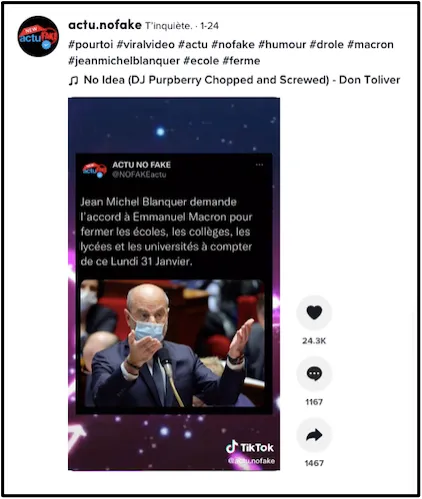
Figure 2
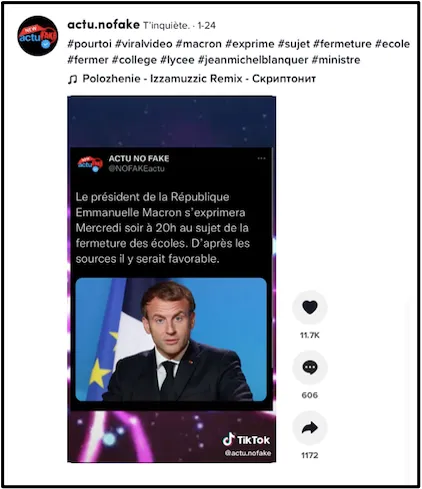
Figure 3
We now know for certain that this was not the case, but it's worth adding that this information was already in complete contradiction with the strategy of the Minister of National Education at the time it was published. Indeed, since the start of the pandemic, he had faced criticism for keeping schools open no matter what, sometimes against scientific recommendations. Through his imprecise statements about infection rates, the spread of contamination in schools was downplayed even as epidemiologists identified them as major clusters of contamination. Mr. Blanquer had also congratulated himself that France was among the OECD countries that had kept its schools closed for the shortest amount of time.
So the information spread by @actu.nofake on TikTok is absolutely false, and it runs counter to the entire strategy of the French government regarding schools. We find this same disinformation effort on Twitter, where @actu.nofake, renamed @NOFAKEactu, simultaneously spreads the same false information as on TikTok (Figure 4). However, it doesn't seem to find the same popularity there: it has only 25 followers on Twitter versus 1,489 on TikTok, and on Twitter its posts get at most 1 retweet compared to 1,467 shares on TikTok.
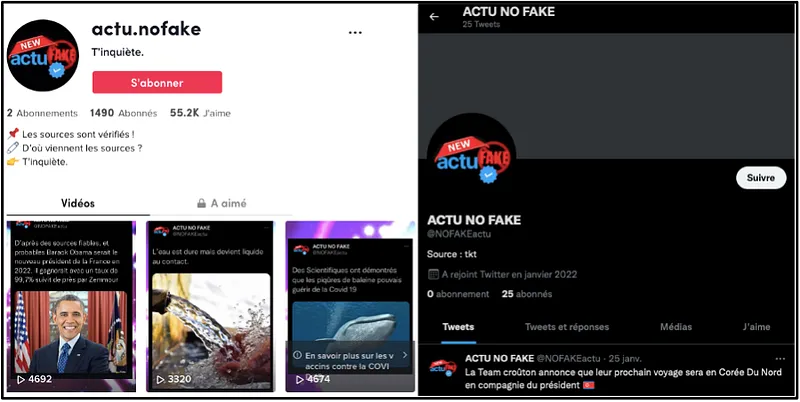
Figure 4
TikTok is today the most-visited website in the world and ranks fiftieth in France, so it is essential to keep an eye on this fake news and its impact during the election period. All the more so since 62% of TikTok's French users are over 17 years old (Figure 5). These potential voters risk having their political opinions skewed by false information that seems authentic simply because it has been viewed so many times.
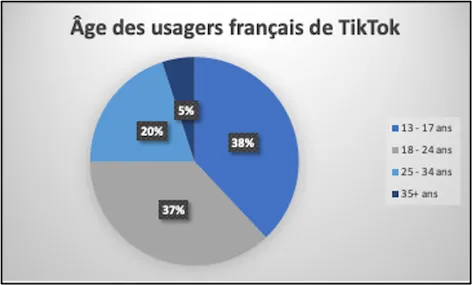
Figure 5
Content moderation could offer a solution to this problem, but the resources social networks currently deploy are far from sufficient to tackle fake news. In 2017, TikTok had promised to reach 10,000 moderators employed, yet they have to moderate videos posted at a rate of one piece of content every 25 seconds. Within TikTok's French branch, moderation is handled mainly by an algorithm that blocks violent content and insults. It is also supplemented by human moderators who understand and speak French. One might still question the working conditions of these moderators given Candice Frazier's testimony; she worked for Telus International, a subcontractor responsible for moderating TikTok's American branch. Frazier filed a complaint over the working conditions imposed by ByteDance, TikTok's parent company. She describes 12-hour days spent watching up to 10 videos simultaneously containing acts of extreme violence: shootings, child pornography, cannibalism, animal mutilation…
So it seems unlikely that the 10,000 moderators TikTok claims to employ worldwide could verify the accuracy of the information published at such a rate, regardless of their working conditions. Unfortunately, it therefore falls to users to exercise caution and critical thinking toward the information they receive. Everyone must verify important information for themselves.
Don't miss our future newsletters !
Get the latest OSINT news, monthly recaps and product updates in your inbox.
More articles from Predicta Lab
February 16, 2022 · 4 min read
Repurposing Content: A Real Political Weapon on TikTok
As part of the presidential campaign, Predicta Lab set up an observatory to monitor conspiracy theories on social media. This article takes a closer look at some of the results discussed during the Anti-complot show on Friday, February 4.
February 23, 2022 · 4 min read
OSINT Tutorial: How to Unmask Disinformation Using Metadata
They say a picture is worth a thousand words, but during disinformation campaigns those words can be lies. Fortunately, there is a type of data that lets open-source researchers spot this kind of manipulation: metadata.
December 29, 2021 · 6 min read
Infodemic: How Did the 'Jean-Michel Trogneux' Rumor Spread?
Natacha Rey, a figure close to conspiracy theorist circles, concluded that the French First Lady is a transgender woman who was previously named Jean-Michel Trogneux. Predicta Lab traces how this conspiracy narrative spread.
August 10, 2026 · 13 min read
DumpSec: unsophisticated but not low-impact
Following the traces of Dumpsec, a French cybercriminal group, across underground forums: how it built its presence, monetized stolen data, and how its own online activity contributed to its downfall.
