
The PHP flaws that switched off governments across Europe
November 2, 2026 · 7 min read

On October 21, Finland's state IT provider pulled the government's public websites off the internet. The Netherlands took down the site of its national cybersecurity agency and the portal Overheid.nl, websites of the French Interior Ministry went dark, Denmark's national school platform followed, and Australia switched off cyber.gov.au. None of these sites had been hacked. Going offline was a precaution, and official guidance said as much: if you cannot apply the fix immediately, unplug.
Two bugs in the code behind most of the web
The cause was PHP2Shell, the name given to two flaws in PHP, the programming language that runs roughly 70 percent of websites whose server-side technology is known, from WordPress and Drupal down to admin panels nobody remembers installing. Both flaws sit in the way PHP manages its memory. Together, they let an attacker take control of a web server from the outside, without any password, or read the secrets it holds, such as passwords and session tokens. Their severity was rated 9.2 out of 10, and some researchers argued for a straight 10.
Fixes were published on October 21 for all supported PHP versions. However, scans counted 5.1 million internet-facing servers running PHP, at least 758,000 of them on versions so old they no longer receive updates, and Cisco Talos estimates that roughly half of the vulnerable systems may never be patched at all.
Known since 2024, fixed in 2026
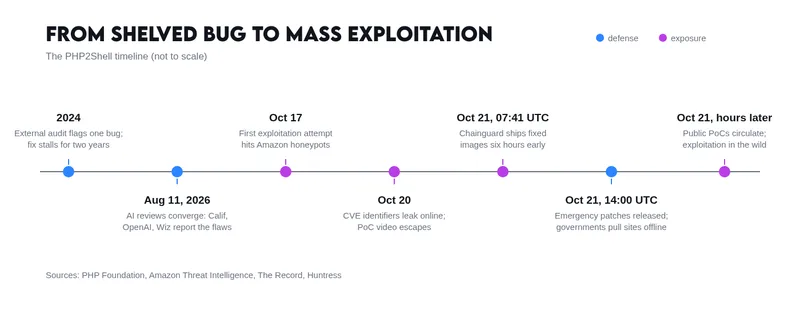
The uncomfortable part of the story predates the outage. One of the two flaws was spotted in 2024, during an external security audit of PHP. Then nothing happened for two years. PHP's security team is small, works by consensus, and feared that every candidate fix would break existing websites or create new problems. Nobody could demonstrate that the flaw was truly exploitable, the handful of core developers were overloaded, and the work stalled. The foundation maintaining the language behind most of the web employs 13 people, full and part time.
In the summer of 2026 the situation changed. A researcher working with an OpenAI model reported the flaws with working attack paths; the security firm Wiz found them independently with its own AI tooling, and other teams converged on the same code. Confronted with proof, the PHP Foundation made the fix its top priority, and later described the two-year delay as a structural failure of its own decision process and resourcing.
Even the release was messy. The flaw identifiers leaked a day early, forcing PHP to move the publication up. A demonstration video was published by mistake and kept circulating after deletion. Most telling, Amazon's decoy servers recorded an exploitation attempt on October 17, four days before anything was public. Once the fixes shipped, new attack attempts were hitting those sensors within hours.
Not an isolated case
The same day, the Node.js project, another building block behind millions of websites and applications, disclosed a comparably severe flaw nicknamed Node2Shell, hidden in a data-compression component it ships. It was found by a security team at OpenAI, and here too the fix had existed since February without anyone realizing it closed a security hole. The Linux operating system had already lived the same story in April: a flaw called Copy Fail, which hands full control of a machine to anyone with an account on it, survived nine years of human review before researchers found it in about an hour with AI assistance.
Detection was only half the problem
It is tempting to conclude that AI has solved the problem of reviewing old code. The tools are clearly effective: three teams independently found the same fourteen-year-old flaws within one summer, and Mozilla, which runs such models against Firefox, fixed 423 security bugs in a single month against a previous average of 21.5, including one that had sat in the code for twenty years.
But the PHP story suggests two reasons for caution. First, attackers get the same tools: working attacks appeared within hours of the fix, and researchers at Epoch AI showed that a freely available model could rediscover and exploit an unpublished Firefox flaw for about 1,000 dollars per attempt. Better detection speeds up both sides of the race.
Second, and more fundamentally, detection was never the whole bottleneck. One of the PHP flaws was known for two years. What was missing was not a finding but a decision: a process able to weigh the risk, people paid to do the work, and the money to fund both. Finding old bugs faster is real progress, but it mostly shortens the time between a flaw being discoverable and it being exploited. As long as the projects underpinning the web are maintained by thirteen people or by nobody at all, the race will be decided less by who finds the bugs than by who can afford to fix them.
Sources: The Record, Huntress, AWS Security Blog, PHP Foundation, Wiz Research, itWire, netfiles, Akamai, The Hacker News, Unit 42 (Palo Alto Networks), Mozilla Blog, The Register, CryptoSlate, Unite.AI (Epoch AI research)
Predicta Graph
Predicta Graph lets you map the results of your investigations into a professional graph.

The professional OSINT graph tool for investigators, fraud teams, recruiters, compliance officers.
On Our Radar
Paid in forest: tracing the timber concession a state handed Wagner for its services
African Arguments reconstructed, from US sanctions files, customs data and the Central African Republic's own transparency reports, how Bangui paid Wagner in trees. A 2021 decree handed the shell company Bois Rouge a 186,596-hectare logging concession, with exports staged from a military base and shipped through a long-time Prigozhin front in St Petersburg. A Wall Street Journal investigation adds that Pavel Prigozhin, the founder's 28-year-old son, still runs the group's CAR empire of gold, arms and tramadol, with annual revenues estimated above 350 million euros by GI-TOC. Most of a sanctioned militia's economy, reconstructed from open records. [ African Arguments // Armees.com ]
52 unpublished photos versus the machines: Bellingcat retests AI geolocation
After Anthropic claimed its models approach superhuman photo geolocation, Bellingcat ran 17 AI models against 52 photos that had never been posted online, with no metadata and a 15 minute limit each. Top models placed more than half the photos within 25 km and several put at least 10 of the 52 within 1 km, and Bellingcat's own tool-equipped agent beat every base model, but none was consistently precise to the exact spot and wrong answers came with confidence. The team's conclusion for investigators: a strong assistant for narrowing an area, not a tool to delegate geolocation to. [ Bellingcat ]
Evidence is everywhere, examiners are not: Europol audits Europe's forensic gap
Europol published a report on October 16, coordinated with the European Commission and drawing on its European Cybercrime Centre, that examines digital forensic capabilities across EU law enforcement. The findings point to a widening gap: investigative tools, resources and expertise are struggling to keep pace with the forms and volume of digital evidence produced by modern technologies, from phone messages to trips logged by connected vehicles and data held in clouds. The report identifies priorities to help investigators lawfully recover and analyse that evidence. [ Europol // IEU Monitoring ]
Not all Doom & Gloom
95 arrests in 17 countries: the operation that followed child abusers' crypto trails
An Interpol-coordinated effort named Confluencia ran four parallel operations from March to September 2026 across 17 countries in Latin America and Europe, ending with 95 arrests and 127 search warrants against producers and distributors of child sexual abuse material. Investigators went after the platforms and cryptocurrency payments used to groom children and sell the content. In Colombia, police safeguarded a five-year-old victim and arrested the parent who was producing and selling the material. [ Interpol // OCCRP ]
London hosts its first practitioner-run OSINT conference
London has a new home for open-source intelligence. On 5 October 2026, the UK OSINT Community held its first Global OSINT Conference with the Police Digital Service, the country’s first event dedicated entirely to OSINT. It brought together practitioners from policing, defence, journalism, academia and the private sector, who until now were spread across separate events. Over the day they shared methods and case studies on organised crime, national security and online harms, and worked towards common ethical standards. The organisers want to make London a global OSINT hub, and they reinvest all revenue into the community. [ Policing Insight ]
Don't miss our future newsletters !
Get the latest OSINT news, monthly recaps and product updates in your inbox.
More newsletters from Predicta Lab
October 5, 2026 · 8 min read
ShinyHunters Says It Hacked the FBI: When the Hunters Come for the Bureau
ShinyHunters claims it stole terabytes of FBI agent and applicant data through the bureau's jobs portal. What is verified, what is only claimed, and why the FBI answered with handcuffs.

September 7, 2026 · 7 min read
TeamPCP Unmasked: A Cat Avatar and a Leaked Password
The newsletter expands beyond OSINT to cybersecurity, CTI and AI. In this issue: how one alias, one leaked password and one cat picture unmasked TeamPCP, the crew behind the longest running spree of software supply chain attacks.

August 3, 2026 · 1 min read
The OSINT Recap: August 2026
This month in OSINT: exposing Africa Corps' involvement in Mali, OSINT's dark side and exploring new investigation tools.

July 6, 2026 · 1 min read
The OSINT Recap: July 2026
This month in OSINT: exposing influence campaigns, following hidden digital trails, investigating AI-generated evidence, exploring new investigation tools and gearing up for an OSINT CTF this September.
